Flagship products where clinical needs, AI, and user workflows converge. 임상 요구, AI, 사용자 워크플로가 하나로 수렴하는 프로덕션 제품들.
Canopus SW · Patented MSI diagnostic system with clinical deployment Canopus SW · 특허 MSI 진단 시스템 — 임상 배포 완료
My role담당 역할
AI R&D Team Lead · Lead AI Engineer: Owned the complete product lifecycle while leading a 3-person team — clinical requirement gathering for Samsung Medical Center, system architecture design, AI model development (ROC-AUC 0.9998), C#–Python integration, IEC 62304-aligned software engineering practices, and production deployment. Currently leading MFDS (Korea FDA) approval, authoring the regulatory documentation and Design History File. AI R&D 팀장 · 리드 AI 엔지니어: 3인 팀을 이끌며 삼성서울병원 대상 임상 요구사항 수집, 시스템 아키텍처 설계, AI 모델 개발(ROC-AUC 0.9998), C#–Python 통합, IEC 62304 정렬 소프트웨어 엔지니어링 실무, 프로덕션 배포까지 전체 제품 주기를 책임졌습니다. 현재 규제 문서와 설계이력파일(DHF)을 작성하며 식약처(MFDS) 인허가를 주도하고 있습니다.
Problem문제
Conventional MSI testing relies on NGS or Genescan: results take 10–14 days, costs are high, and interpretation depends on scarce expert analysts. MSI detection from digital-PCR melting data was unreliable in research and absent in production. Clinical labs need a certified system that combines data analysis + AI scoring + operator review + PDF export while meeting strict regulatory and security standards. 기존 MSI 검사는 NGS·Genescan에 의존합니다 — 결과 회신까지 10–14일, 높은 비용, 숙련 분석 인력 부족이라는 한계가 있습니다. 디지털 PCR 멜팅 데이터의 MSI 검출은 연구에서 신뢰성이 낮고 프로덕션에는 부재했습니다. 임상실험실은 데이터 분석 + AI 스코어링 + 운영자 검토 + PDF 내보내기를 결합하면서 엄격한 규제·보안 기준을 충족하는 인증 시스템이 필요합니다.
Solution해결책
Canopus is a digital-melting-based AI determination software that analyzes the GenSpectra™ MSI Kit (real-time digital PCR + high-resolution melting). It ingests BAT26 / CAT25 melting data, generates Tm histograms, and an ML classifier predicts an MSI Score that auto-classifies each sample as MSI-H / Borderline / MSS — returning a result in ~85 minutes with no expert review required. Built as a 3-layer architecture: C# UI (workflows) · C# signal processing (PCR/melting) · Python AI (patented Tm extraction + MSI scoring), with medical-grade security: encryption, access control, audit trails, compliance docs. Canopus는 GenSpectra™ MSI Kit(real-time 디지털 PCR + 고해상도 멜팅, HRM)를 분석하는 디지털 멜팅 기반 AI 판정 소프트웨어입니다. BAT26 / CAT25 멜팅 데이터를 입력받아 Tm 히스토그램을 생성하고, ML 분류기가 MSI Score를 예측해 각 검체를 MSI-H / Borderline / MSS로 자동 분류합니다 — 전문가 판독 없이 약 85분 만에 결과를 제공합니다. 3계층 구조로 구축: C# UI(워크플로) · C# 신호 처리(PCR/멜팅) · Python AI(특허 Tm 추출 + MSI 스코어링). 의료 등급 보안: 암호화, 접근 제어, 감사 추적, 준수 문서.
C# UI LayerC# UI 레이어
Sample management · MSI score visualization · Threshold interpretation · Operator review workflow · PDF export with audit trails.샘플 관리 · MSI 점수 시각화 · 임계값 해석 · 운영자 검토 · 감사 추적 PDF 내보내기.
C# Analysis EngineC# 분석 엔진
Digital PCR + melting curve analysis · Preprocessing · Tm distribution modeling · QA checks · AI-ready data structures.PCR + 멜팅 커브 분석 · 전처리 · Tm 분포 모델링 · QA 확인 · AI 준비 데이터.
Python AI ModulePython AI 모듈
Patented Tm feature extraction · ML-based MSI-H scoring · Confidence metrics · Model validation.특허 Tm 특성 추출 · ML 기반 MSI-H 스코어링 · 신뢰도 지표 · 모델 검증.
How the AI determines MSIAI가 MSI를 판정하는 방식
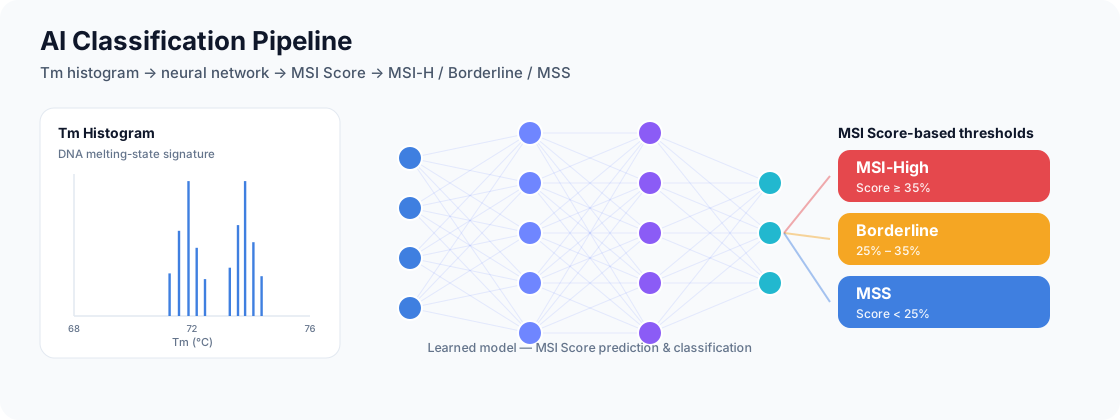
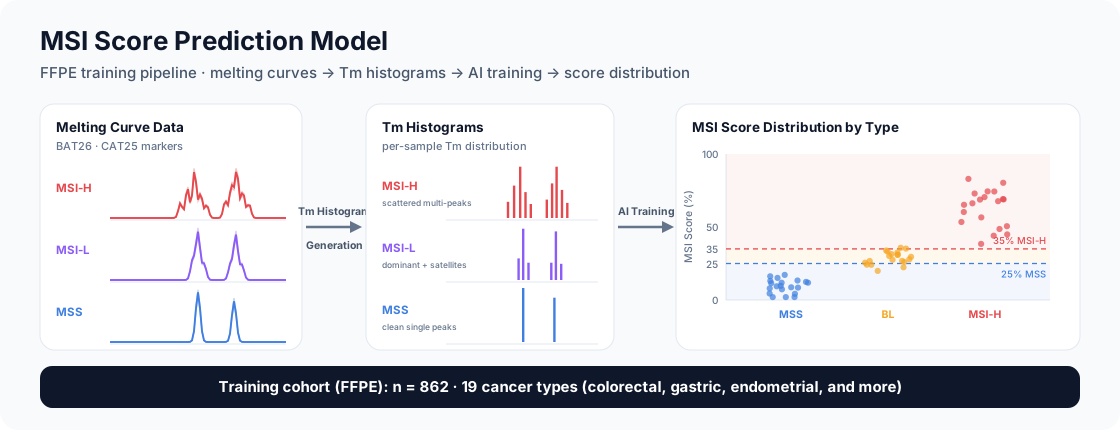
Trained on a labeled FFPE cohort (MSS · Borderline · MSI-H), the classifier learns the Tm-histogram patterns that distinguish microsatellite-stable from MSI-high samples. At inference, each new sample's BAT26 / CAT25 melting distribution is converted into a Tm histogram, the model outputs an MSI Score (%), and thresholds auto-classify the result: MSI-H ≥ 35% · Borderline 25–35% · MSS < 25%. A "data flywheel" lets the model be retrained as testing data accumulates, steadily improving accuracy across versions. 라벨링된 FFPE 코호트(MSS · Borderline · MSI-H)로 학습한 분류기는 현미부수체 안정(MSS)과 MSI-high 검체를 구분하는 Tm 히스토그램 패턴을 학습합니다. 추론 단계에서 새 검체의 BAT26 / CAT25 멜팅 분포를 Tm 히스토그램으로 변환하면 모델이 MSI Score(%)를 산출하고, 임계값이 결과를 자동 분류합니다: MSI-H ≥ 35% · Borderline 25–35% · MSS < 25%. "데이터 선순환(Data Flywheel)" 구조로 검사 데이터가 쌓일수록 모델을 재학습해 버전을 거치며 정확도를 지속 개선합니다.
What the classifier reads — Tm histogram signature by MSI type분류기가 읽는 신호 — MSI 유형별 Tm 히스토그램 시그니처
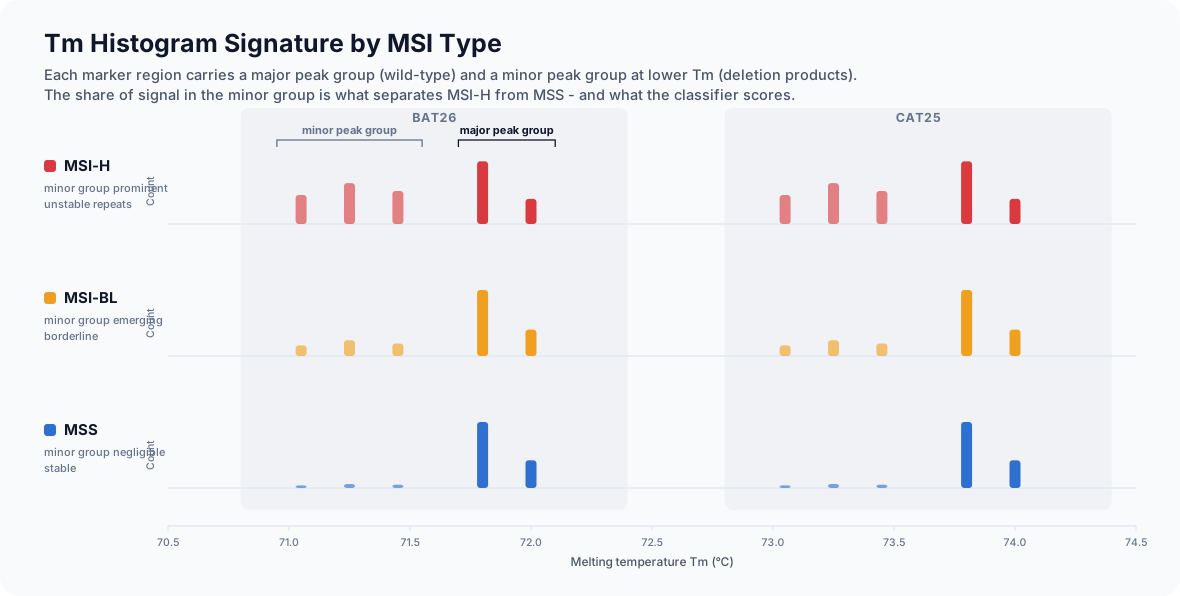
Within each marker region, the major peak group is the wild-type allele and the minor peak group at lower Tm comes from deletion products. Instability shifts signal into the minor group — that shift is what the MSI Score quantifies. 각 마커 영역에서 major peak group은 정상(wild-type) 대립유전자, 낮은 Tm 쪽의 minor peak group은 결실(deletion) 산물입니다. 불안정성이 커질수록 신호가 minor group으로 이동하며, MSI Score는 이 이동량을 정량화합니다.
Competitive positioning경쟁 포지셔닝
vs. NGS (FoundationOne CDx)vs. NGS (FoundationOne CDx)
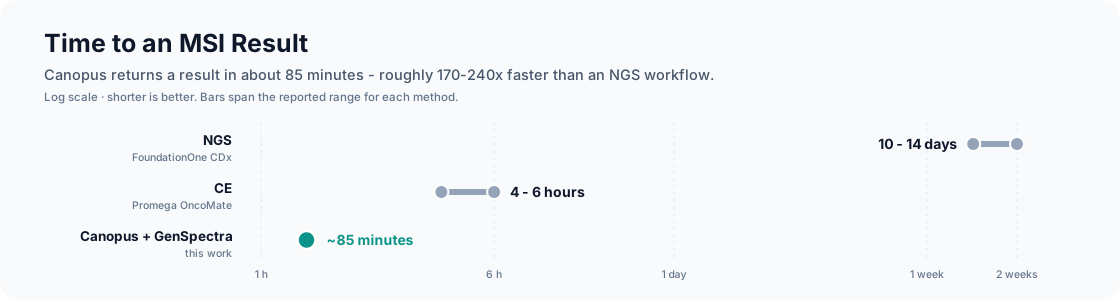
NGS: 95+ loci, 10–14 days, high cost. Canopus + GenSpectra: 2 markers, ~85 min, no matched-normal needed.NGS: 95+ loci, 10–14일, 고비용. Canopus + GenSpectra: 2개 마커, 약 85분, 정상 대조 검체 불필요.
vs. CE (Promega OncoMate)vs. CE (Promega OncoMate)
Capillary electrophoresis: 4–6 h, manual peak-shift review, internal control required. Canopus: AI score-based, no internal control.모세관 전기영동: 4–6시간, 수기 피크 시프트 판독, 내부 대조 필요. Canopus: AI 스코어 기반, 내부 대조 불필요.
Performance성능
100% sensitivity (MSI-H, zero false negatives) · 97.52% specificity (MSS) · FFPE tissue used directly, no matched normal.MSI-H 민감도 100%(위음성 0건) · MSS 특이도 97.52% · FFPE 조직 직접 사용, 정상 대조 불필요.
Time to result — Canopus vs. NGS and capillary electrophoresis결과까지 걸리는 시간 — Canopus vs. NGS · 모세관 전기영동
Impact & Achievement성과 & 달성
- Granted patent KR 10-2997641특허 등록 KR 10-2997641 — "Method and System for Improving Digital Melting Analysis Accuracy", delivering 2–10× signal resolution over existing methods; 2 further applications pending"디지털 멜팅 분석 정확도 향상 방법 및 시스템" — 기존 방법 대비 2–10× 신호 해상도 향상, 2건 추가 출원 중
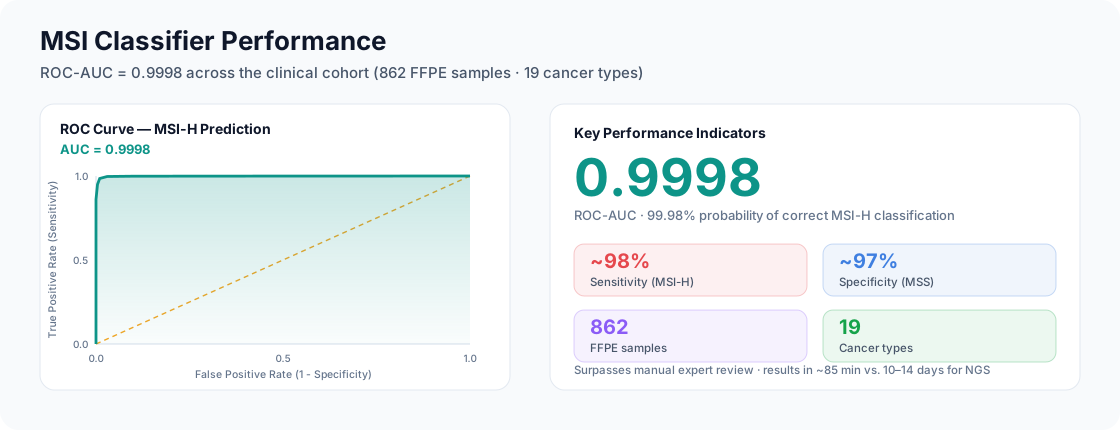
- ROC-AUC up to 0.9998 — MSI-Classifier validated across a clinical dataset of 862 FFPE samples spanning 19 cancer types (colorectal, gastric, endometrial, and more)19개 암종(대장·위·자궁내막 등)에 걸친 862개 임상 FFPE 검체 데이터셋에서 MSI-Classifier 검증
- Solved the clinical-data bottleneck임상 데이터 병목 해결 — built Tm Histogram Generator to synthesize validated virtual training data and pre-train the model, overcoming the shortage of labeled FFPE samples that limits deep-learning diagnosticsTm Histogram Generator를 개발해 검증된 가상 학습 데이터를 합성하고 모델을 사전학습, 딥러닝 진단의 발목을 잡는 라벨 FFPE 검체 부족 한계를 극복
- 100% / 97.52% — sensitivity (MSI-H, zero false negatives; 95% CI lower bound 97.3%) and specificity (MSS); results in ~85 min vs. 10–14 days for NGSMSI-H 민감도 100%(위음성 0건, 95% 신뢰구간 하한 97.3%) · MSS 특이도 97.52% — NGS의 10–14일 대비 약 85분 내 결과 제공
- Clinical deployment readiness임상 배포 준비도 — production-focused quality controls with encrypted data, audit trails, and security documentation; IEC 62304-aligned release (V.1.3) with IFU암호화 데이터, 감사 추적, 보안 문서화를 포함한 프로덕션 중심 품질 관리 — IFU를 갖춘 IEC 62304 정렬 릴리스(V.1.3)
- Currently deployed in pathology labs병리학 실험실 현재 배포 운용 중 — clinicians report improved workflow efficiency and result confidence임상의들이 워크플로 효율성과 결과 신뢰도 향상을 보고
Key decisions & tradeoffs핵심 의사결정 및 트레이드오프
Why C#–Python integration instead of a pure Python stack?순수 Python 스택 대신 C#–Python 통합을 선택한 이유는?
Hybrid C# UI + Python AI across a clean IPC boundary. C# gives the real-time responsiveness and platform stability a clinical workflow needs; Python keeps ML development fast. Each tier scales independently.C# UI + Python AI 하이브리드를 깔끔한 IPC 경계로 연결. C#는 임상 워크플로에 필요한 실시간 반응성·플랫폼 안정성을, Python은 빠른 ML 개발을 제공하며 각 계층을 독립적으로 확장합니다.
A pure Python desktop stack — simpler to build, but weaker UI latency guarantees and less predictable behaviour on regulated Windows deployments.순수 Python 데스크톱 스택 — 개발은 단순하지만 UI 지연 보장이 약하고 규제 Windows 배포에서 동작 예측성이 떨어집니다.
Tradeoff accepted:감수한 트레이드오프: two runtimes to package, version and validate — absorbed by shipping each model release as one self-contained versioned artifact.두 런타임을 패키징·버전관리·검증해야 하는 부담 — 모델 릴리스를 자기완결적 버전 아티팩트 하나로 묶어 해소했습니다.
Model accuracy vs. inference speed in production프로덕션에서 모델 정확도 vs. 추론 속도
Accuracy first — ROC-AUC 0.9998 with 100% MSI-H sensitivity. An MSI misclassification changes a treatment decision, so a false negative costs far more than a slow result.정확도 우선 — ROC-AUC 0.9998, MSI-H 민감도 100%. MSI 오분류는 치료 결정을 바꾸므로, 위음성의 대가가 느린 결과보다 훨씬 큽니다.
A lighter model tuned for throughput — faster per sample, but giving up margin on exactly the class that must never be missed.처리량에 맞춘 경량 모델 — 검체당 속도는 빠르지만, 절대 놓쳐선 안 되는 클래스에서 여유를 포기하게 됩니다.
Tradeoff accepted:감수한 트레이드오프: heavier compute per sample — bounded to <2 s per result through quantization and batch processing, so lab throughput is unaffected.검체당 연산량 증가 — 양자화와 배치 처리로 결과당 <2초로 묶어 실험실 처리량에는 영향이 없습니다.
How IEC 62304 shaped the architectureIEC 62304가 아키텍처를 형성한 방식
Hard module boundaries — regulated C# data handling separated from Python research algorithms, with version-controlled model checkpoints and full audit logging.엄격한 모듈 경계 — 규제 대상인 C# 데이터 처리와 Python 연구 알고리즘을 분리하고, 모델 체크포인트를 버전 관리하며 전체 감사 로깅을 적용했습니다.
One tightly coupled application — less plumbing, but every algorithm tweak would re-open the regulated scope and its documentation.강결합 단일 애플리케이션 — 배관 작업은 줄지만, 알고리즘을 수정할 때마다 규제 범위와 문서가 다시 열립니다.
Tradeoff accepted:감수한 트레이드오프: more upfront design and interface work — repaid by cheap compliance documentation and low-risk change management across v1.0 → v1.3.초기 설계·인터페이스 작업 증가 — v1.0 → v1.3 전반에서 컴플라이언스 문서화 비용과 변경 리스크를 낮춰 회수했습니다.
Engineering excellence엔지니어링 특징
Clinical requirements shaped architecture; patented innovations enabled superior AI performance; seamless C#–Python integration proved robust in production; comprehensive regulatory documentation supports lab adoption and compliance audit. 임상 요구사항이 아키텍처를 결정했고, 특허 혁신이 우월한 AI 성능을 가능하게 했으며, 원활한 C#–Python 통합이 프로덕션에서 견고성을 증명했고, 포괄적인 규제 문서화가 실험실 도입과 컴플라이언스 감사를 지원합니다.
Product direction제품 방향성
Canopus is OPTOLANE's first AI analysis platform — MSI is the entry point, and the validated architecture extends to further diagnostic targets. Canopus는 OPTOLANE의 첫 AI 분석 플랫폼입니다 — MSI를 시작점으로, 검증된 구조를 추가 진단 항목으로 확장합니다.
Now (V.1.x)현재 (V.1.x)
MSI module launch & stabilization · confirmatory clinical trial support · integrated dashboard + one-click PDF report.MSI 모듈 출시·안정화 · 확증 임상시험 대응 · 통합 대시보드 + 원클릭 PDF 리포트.
Next다음 단계
Multi-product selection · MLH1 and additional analysis targets · user-configurable decision thresholds.다중 제품 선택 기능 · MLH1 등 분석 항목 확장 · 사용자 설정 판정 임계값.
Mid–long term중장기
Built-in AI retraining · advanced reporting + multilingual support · multi-target analysis platform.AI 재학습 기능 내장 · 리포트 고도화 + 다국어 지원 · 다중 타깃 분석 플랫폼화.
AI classification pipeline — Tm Histogram → neural network → MSI Score → MSI-H / Borderline / MSSAI 분류 파이프라인 — Tm 히스토그램 → 신경망 → MSI Score → MSI-H / Borderline / MSS
MSI score prediction model — FFPE training pipeline (n=862, 19 cancer types)MSI 점수 예측 모델 — FFPE 학습 파이프라인 (n=862, 19개 암종)
MSI classifier performance — ROC-AUC = 0.9998 across the clinical cohortMSI 분류기 성능 — 임상 코호트 전체 ROC-AUC = 0.9998
Overcoming limited clinical data — synthetic Tm-histogram pre-training임상 데이터 부족의 극복 — 합성 Tm 히스토그램 사전학습(pre-training)
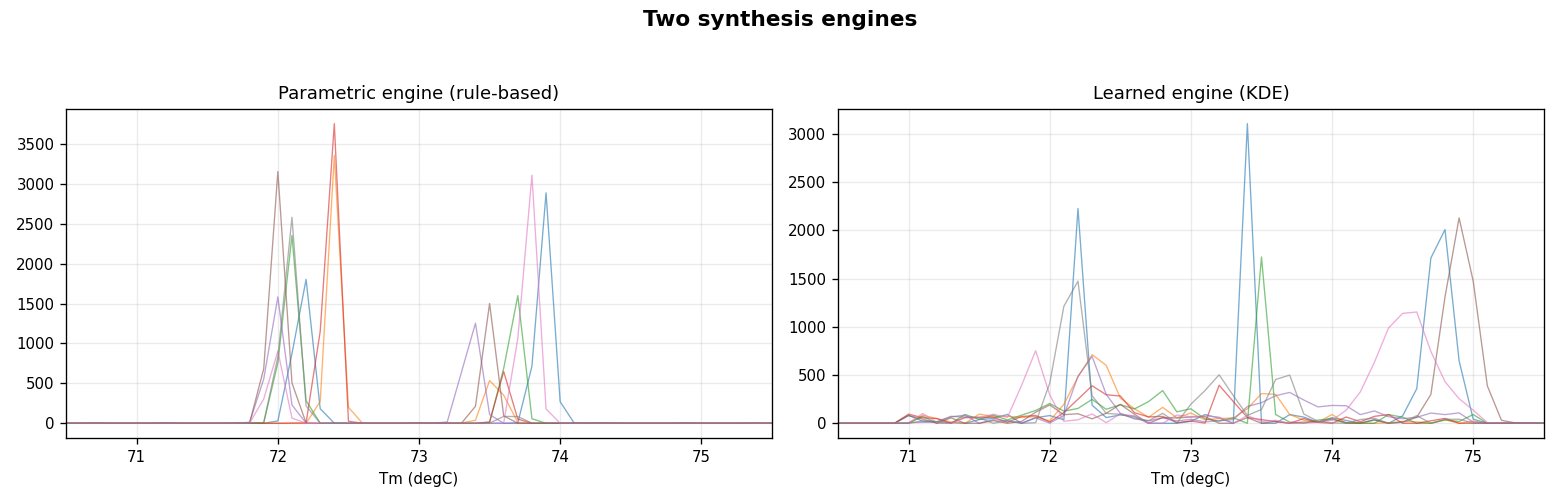
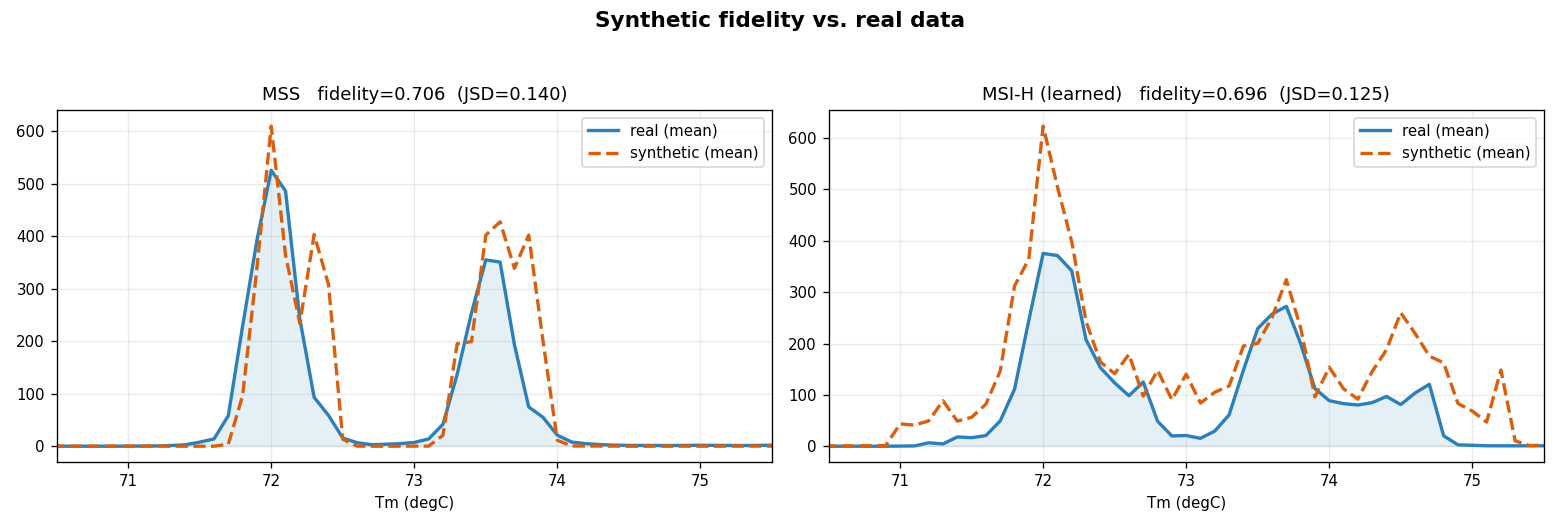
The hardest constraint in building the MSI classifier was the scarcity of labeled clinical FFPE samples — too few, and too imbalanced across cancer types, to train a robust deep model on their own. To break through this ceiling I built Tm Histogram Generator, a tool that synthesizes realistic virtual Tm histograms statistically matched to real clinical distributions (validated with Jensen–Shannon divergence). The classifier is pre-trained on this large synthetic corpus and then fine-tuned on the limited real data — turning a data shortage into a solved problem and measurably improving robustness and generalization across the 19-cancer-type cohort. MSI 분류기 개발에서 가장 큰 제약은 라벨링된 임상 FFPE 검체의 부족이었습니다 — 견고한 딥러닝 모델을 학습하기에는 절대량이 적고 암종별 분포도 불균형했습니다. 이 한계를 돌파하기 위해 Tm Histogram Generator를 직접 개발했습니다. 실제 임상 분포와 통계적으로 일치(Jensen–Shannon divergence로 검증)하는 가상 Tm 히스토그램을 대량으로 합성하는 도구입니다. 이 대규모 합성 데이터로 분류기를 사전학습(pre-training)한 뒤 제한된 실제 데이터로 미세조정하여, 데이터 부족이라는 한계를 해결하고 19개 암종 코호트 전반에서 견고성과 일반화 성능을 실질적으로 향상시켰습니다.
Two synthesis engines — parametric (rule-based) vs. learned (KDE)두 가지 합성 엔진 — 파라메트릭(규칙 기반) vs. 학습(KDE)
Synthetic fidelity vs. real data — JSD-validated Tm distributions합성 데이터 충실도 검증 — JSD로 검증한 Tm 분포
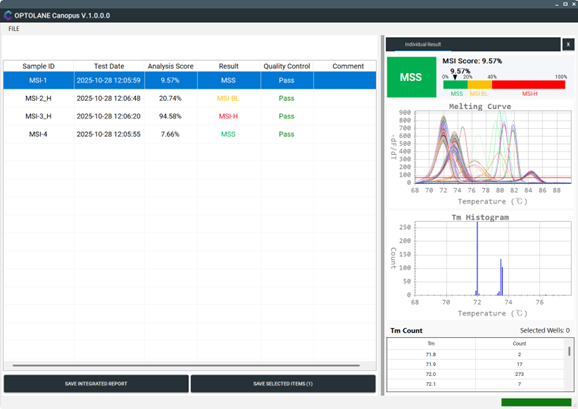
Dashboard — sample list, MSI scores & QC status (MSS example)대시보드 — 샘플 목록, MSI 점수, QC 상태 (MSS 예시)
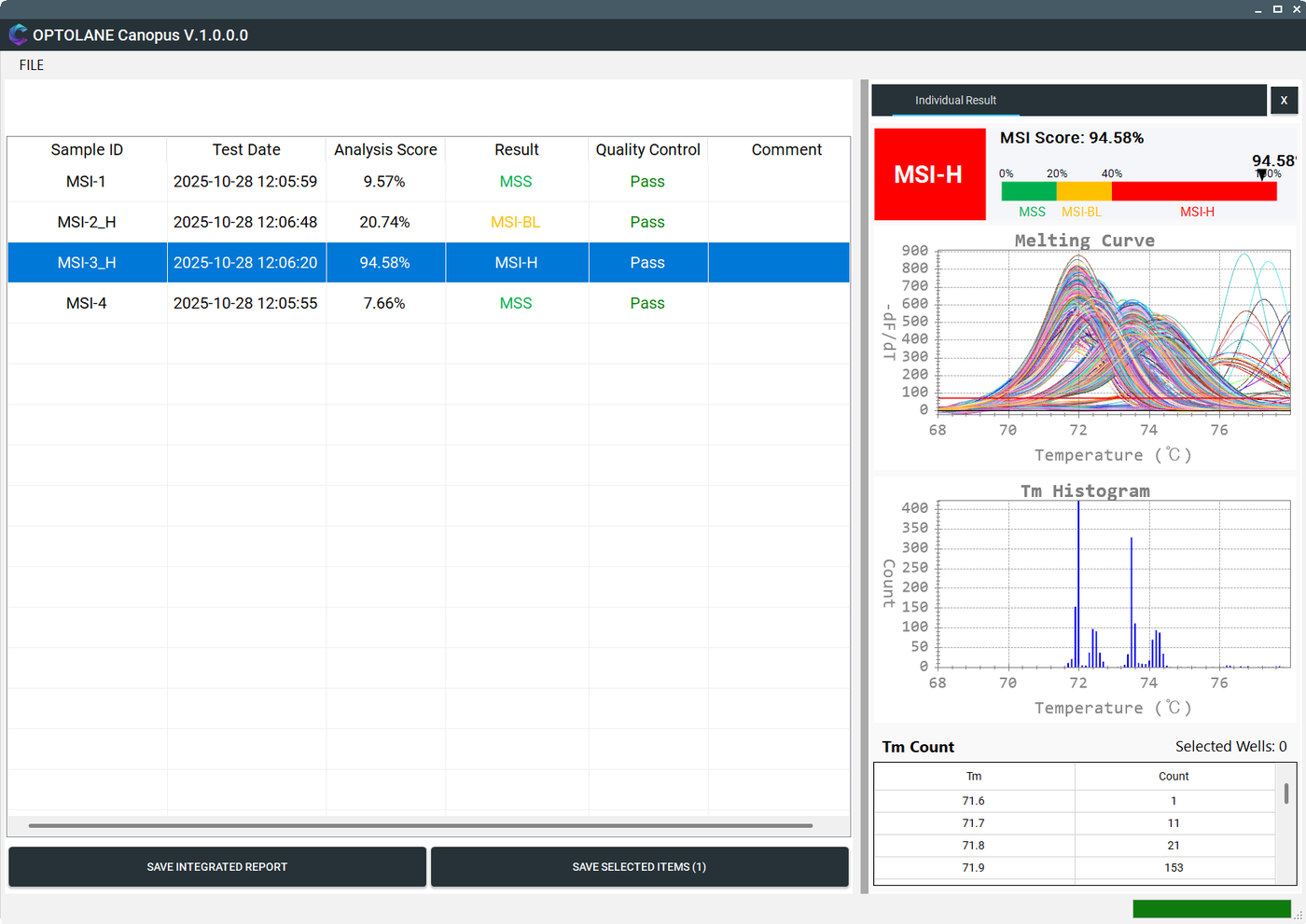
Individual result — MSI-H sample: melting curve, Tm histogram & MSI score개별 결과 — MSI-H 검체: 멜팅 커브, Tm 히스토그램, MSI 점수
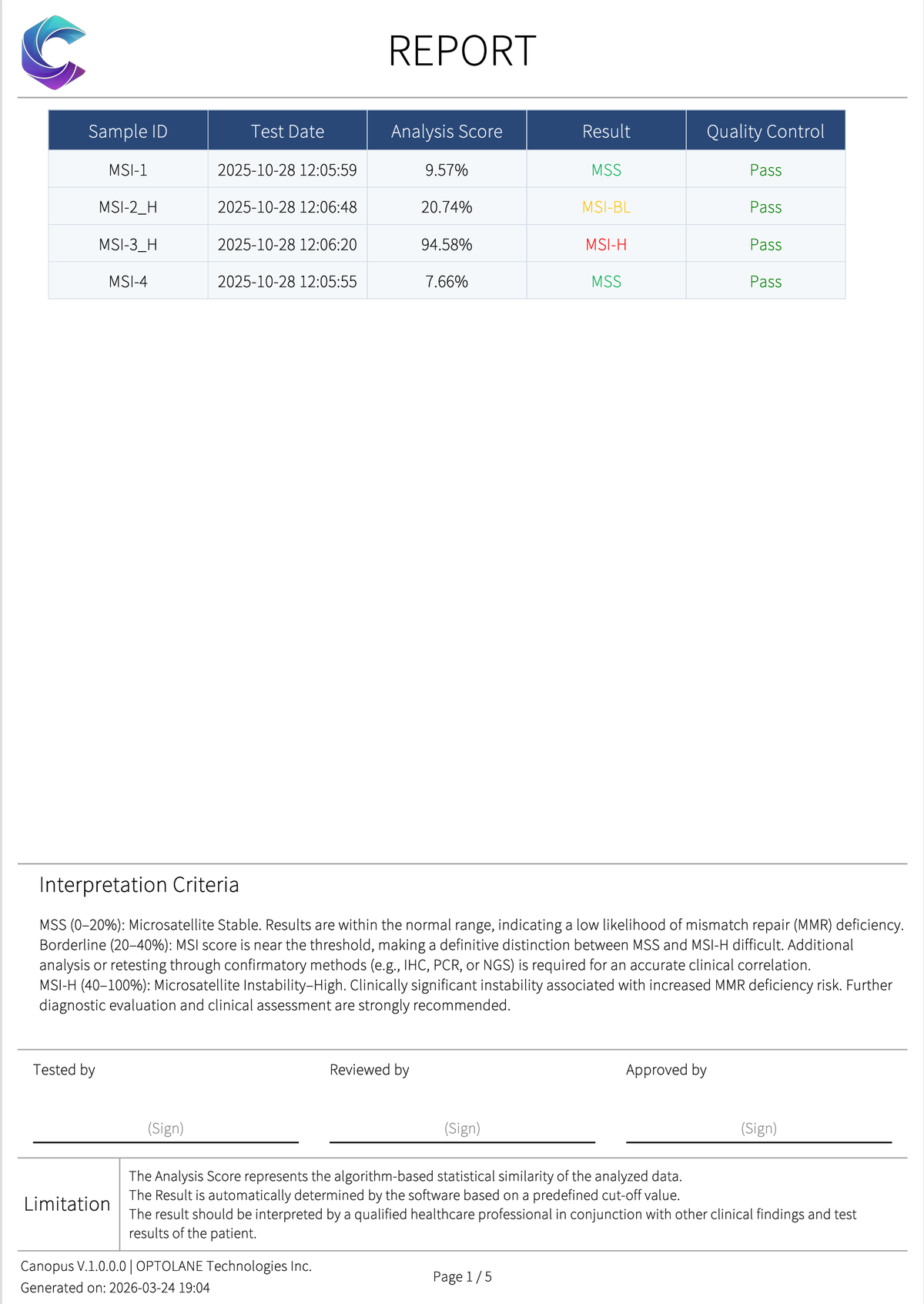
Clinical PDF report — one-click export: result table, interpretation criteria & sign-off임상 PDF 리포트 — 원클릭 내보내기: 결과 테이블, 판정 기준, 서명란
Drag & drop ODPI result files or a folderODPI 결과 파일·폴더 드래그 & 드롭
Tm histogram + AI scoring with QC pass/failTm 히스토그램 + AI 스코어링, QC 판정
MSI scores, thresholds & sample listMSI 점수·임계값·샘플 목록 확인
Melting curve & Tm histogram per sample검체별 멜팅 커브·Tm 히스토그램
Integrated or per-sample clinical report통합·개별 임상 리포트 출력
CGT AI Pipeline · Automating cell therapy quality analysis CGT AI 파이프라인 · 세포 치료제 품질 분석 자동화
Background배경
Cell Gene Therapy (CGT) uses viral vectors to deliver genetic material into individual cells. To assess whether this delivery worked — and at what potency — researchers need to know how many viral copies entered each cell. This is measured through Cell Number Variation (CNV) analysis: a metric that requires correlating each cell's count with its corresponding PCR signal in the same reaction zone. 세포 유전자 치료(CGT)는 바이러스 벡터를 이용해 개별 세포에 유전 물질을 전달합니다. 이 전달이 효과적으로 이루어졌는지, 그 효능이 어느 정도인지 평가하려면 각 세포에 바이러스 복제물이 몇 개나 침투했는지를 알아야 합니다. 이를 Cell Number Variation(CNV) 분석이라 하며, 각 반응 구역(well)의 세포 수와 동일 구역의 PCR 신호를 정밀하게 연동해야 측정됩니다.
Problem문제
Counting cells in each reaction well requires a researcher to manually inspect dozens of microscope images — a process that is slow, subject to operator bias, and impossible to scale for clinical throughput. Without accurate, automated cell counts, CNV analysis cannot reliably quantify viral transduction efficiency or assess cell therapy quality. 각 반응 구역의 세포를 계수하려면 연구자가 수십 장의 현미경 이미지를 수작업으로 검토해야 합니다. 이는 느리고 운영자에 따라 결과가 달라지며 임상 수준의 처리량에 대응할 수 없습니다. 정확하고 자동화된 세포 계수 없이는 바이러스 침투 효율 측정이나 세포 치료제 품질 평가에서 CNV 분석의 신뢰성을 확보하기 어렵습니다.
Solution해결책
An automated dual-track pipeline that simultaneously processes optical microscope images and digital real-time PCR measurements. The system maps each reaction zone precisely using a pre-designed well layout, separates individual well images, counts cells with a deep learning model, then integrates the results with PCR data — delivering per-well CNV values fully automatically. 광학 현미경 이미지와 디지털 실시간 PCR 측정값을 동시에 처리하는 자동화 이중 트랙 파이프라인입니다. 사전 설계된 웰 레이아웃을 기반으로 각 반응 구역의 위치를 정밀하게 매핑하고, 개별 웰 이미지를 분리한 뒤, 딥러닝 모델로 세포를 계수하고, 이를 PCR 데이터와 연동해 웰별 CNV 값을 완전 자동으로 도출합니다.
Why it matters임상적 중요성
- Viral transduction efficiency — quantifies exactly how many viral copies entered each individual cell, the key metric in cell therapy potency assessment바이러스 침투 효율 — 개별 세포에 침투한 바이러스 복제물 수를 정밀 정량화, 세포 치료제 효능 평가의 핵심 지표
- Cell therapy quality control — enables reliable, operator-independent evaluation of whether the gene delivery worked at the single-cell level세포 치료제 품질 관리 — 단일 세포 수준에서 유전자 전달 성공 여부를 운영자 편향 없이 신뢰성 있게 평가
- >99.5% cell recognition accuracy — trained and validated on ~10,000 well images; deep learning replaces manual counting with objective, reproducible results at any scale>99.5% 세포 인식 정확도 — 약 10,000장의 웰 이미지로 학습·검증. 딥러닝이 수작업 계수를 대체해 어떤 규모에서도 객관적이고 재현 가능한 결과를 제공합니다
- Full prototype delivered in 2 months — end-to-end system including UI and analysis functions2개월 내 완전한 프로토타입 납품 — UI 및 분석 기능을 포함한 엔드투엔드 시스템
Key decisions & tradeoffs핵심 의사결정 및 트레이드오프
Why a dual-track microscopy + PCR pipeline rather than one modality?단일 모달리티 대신 현미경 + PCR 이중 트랙을 택한 이유는?
Both tracks, cross-checked. If the cell count and the PCR signal for a well disagree, the system flags it — a self-validating design that raises confidence in every CNV value.두 트랙을 교차 검증. 같은 웰의 세포 수와 PCR 신호가 어긋나면 시스템이 플래그를 띄우는 자체 검증 구조로, 모든 CNV 값의 신뢰도를 높입니다.
Either track alone: cell counts carry no potency context, and PCR signal alone has no ground truth for how many cells produced it.한쪽 트랙만 사용: 세포 계수만으로는 효능 맥락이 없고, PCR 신호만으로는 몇 개의 세포에서 나온 신호인지 기준값이 없습니다.
Tradeoff accepted:감수한 트레이드오프: two acquisition paths to align spatially — solved once with a pre-designed well grid and alignment markers.두 취득 경로를 공간적으로 정렬해야 하는 부담 — 사전 설계된 웰 격자와 정렬 마커로 한 번에 해결했습니다.
Labeling effort vs. model robustness, inside a two-month prototype window2개월 프로토타입 일정 안에서 라벨링 비용 vs. 모델 견고성
Label small, augment hard. 5K carefully labeled reference cells from diverse wells, expanded to 50K+ via rotation and elastic deformation plus semi-supervised learning → >99.5% accuracy.적게 라벨하고 강하게 증강. 다양한 웰에서 5천 개를 정밀 라벨링한 뒤 회전·탄성 변형과 반감독 학습으로 5만+ 샘플로 확장 → >99.5% 정확도.
Exhaustive manual labeling for maximum coverage — more robust in principle, but impossible to finish inside the delivery window.최대 커버리지를 위한 전수 수작업 라벨링 — 원칙적으로 더 견고하지만 납기 안에 끝낼 수 없습니다.
Tradeoff accepted:감수한 트레이드오프: thinner coverage of rare edge cases, which is why the limitations below are stated explicitly rather than hidden.희귀 엣지 케이스 커버리지 부족 — 그래서 아래 한계를 숨기지 않고 명시합니다.
Known limitations — and how each is contained알려진 한계 — 그리고 각각의 통제 방법
Overlapping cells (~5% of wells) count as one cluster. Noisy wells (precipitation, bubbles) are unreliable. Domain shift across microscope optics and staining batches costs 2–5% accuracy.세포 중첩(웰의 약 5%)은 하나의 클러스터로 계수됩니다. 노이즈 웰(침전·기포)은 신뢰도가 낮습니다. 도메인 시프트(현미경 광학·염색 배치 차이)는 정확도를 2–5% 떨어뜨립니다.
Undercount by design — conservative for safety. Noisy wells raise a manual-inspection flag instead of a silent number. Well-layout registration preprocessing absorbs most domain shift.의도적으로 과소 계수하여 안전 측 보수적 판정. 노이즈 웰은 조용히 숫자를 내지 않고 수동 검사 플래그를 띄웁니다. 웰 레이아웃 등록 전처리가 도메인 시프트 대부분을 흡수합니다.
Next:향후 과제: attention-based instance segmentation to split touching cells, and transfer-learned multi-microscope models.맞닿은 세포를 분리하는 어텐션 기반 인스턴스 분할, 전이학습 기반 다중 현미경 모델.
How CNV Analysis Works — Three-Stage OverviewCNV 분석 작동 원리 — 3단계 개요
Well Localization웰 위치 파악
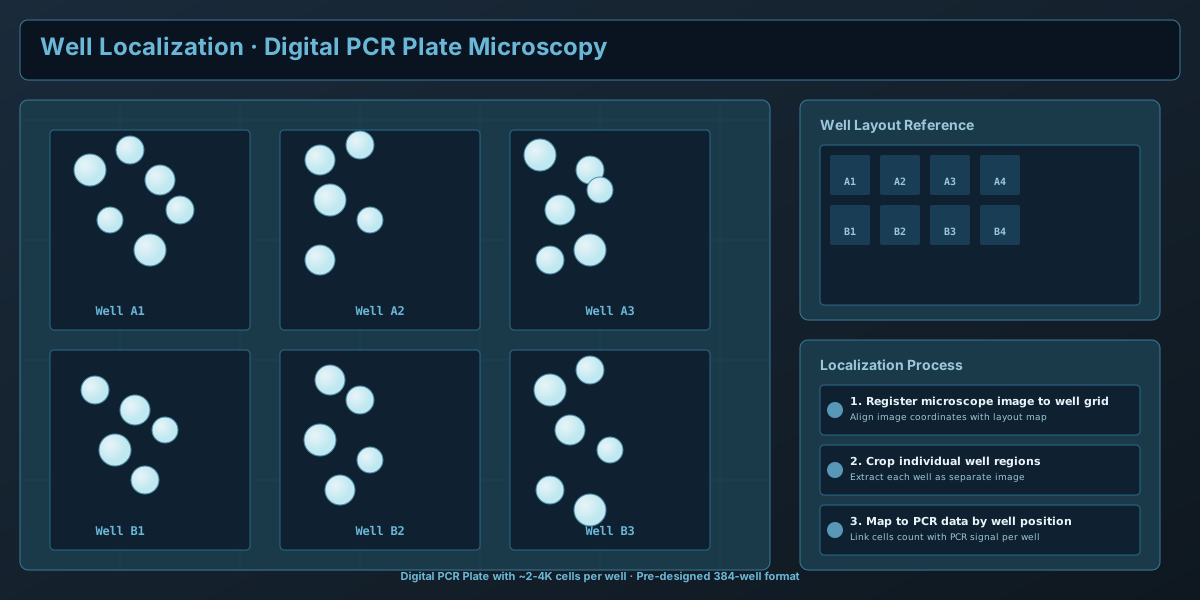
A pre-designed well grid map is used to precisely locate each reaction zone within the microscope image. Each well is then separated as an individual image for downstream analysis. 사전 설계된 웰 격자 맵으로 현미경 이미지 내 각 반응 구역의 위치를 정밀하게 파악합니다. 이후 각 웰을 개별 이미지로 분리하여 다음 단계에서 분석합니다.
AI Cell CountingAI 세포 계수
A deep learning model automatically identifies and counts every cell within each separated well image — replacing manual microscope counting with objective, reproducible results. 딥러닝 모델이 분리된 각 웰 이미지에서 모든 세포를 자동으로 감지하고 계수합니다. 수작업 현미경 계수를 객관적이고 재현 가능한 결과로 대체합니다.
CNV AnalysisCNV 분석
Cell count per well is matched with the PCR signal from the same well, revealing how many viral gene copies entered each cell. 웰별 세포 수를 동일 웰의 PCR 신호와 매칭하여 각 세포에 몇 개의 바이러스 유전자 복제물이 침투했는지 측정합니다.
| Well웰 | Cell Count세포 수 | CNV |
|---|---|---|
| #2 | 102 | 1.71 |
| #8 | 174 | 2.52 |
| #24 | 215 | 2.80 |
Automated Pipeline — How the two data sources are unified자동화 파이프라인 — 두 데이터 소스의 통합 과정
Using the well grid map, identify exactly where each reaction zone is in the microscope image and extract it as an individual image.웰 격자 맵으로 현미경 이미지 내 각 반응 구역의 위치를 특정하고 개별 이미지로 추출합니다.
Extract and process the PCR amplification signal from each individual reaction zone to quantify gene copy numbers.각 반응 구역의 PCR 증폭 신호를 추출하고 처리하여 유전자 복제 수를 정량화합니다.
A deep learning model detects and counts every cell within each separated well image — automatically and objectively.딥러닝 모델이 분리된 각 웰 이미지 내 모든 세포를 자동으로 감지하고 객관적으로 계수합니다.
Align PCR signal data with the spatially indexed well positions so every well's signal corresponds to the correct reaction zone.PCR 신호 데이터를 공간적으로 인덱싱된 웰 위치와 정렬하여 모든 웰의 신호가 올바른 반응 구역에 대응하도록 합니다.
Cell count per well is combined with the PCR signal from the same well to compute the CNV value — the number of viral gene copies per cell. This directly measures how effectively the viral vector delivered its genetic cargo into individual cells.웰별 세포 수와 동일 웰의 PCR 신호를 결합하여 CNV 값, 즉 세포당 바이러스 유전자 복제 수를 산출합니다. 이는 바이러스 벡터가 개별 세포에 유전적 화물을 얼마나 효과적으로 전달했는지를 직접 측정하는 지표입니다.
Open-source demo — public reference implementation of the CGT / CNV pipeline오픈소스 데모 — CGT / CNV 파이프라인의 공개 참조 구현
LOAA-M · Diagnostic PCR Platform — Qt UI, AWS integration & cybersecurity LOAA-M · 진단 PCR 플랫폼 — Qt UI, AWS 연동 & 사이버 보안
What it is제품 개요
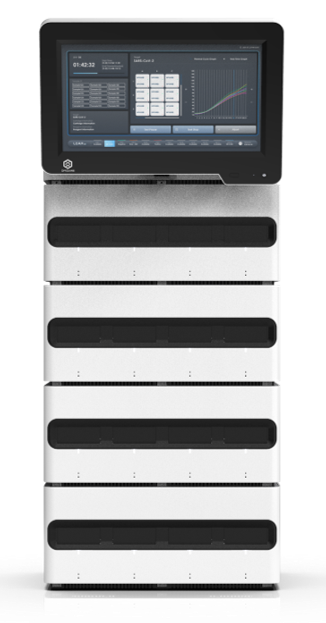
LOAA-M is OPTOLANE's molecular diagnostic PCR instrument platform for clinical laboratories. The software stack drives real-time diagnostic data acquisition, analysis, cloud synchronization, and secure data management — operating in certified medical environments across Linux and Windows. LOAA-M은 임상 실험실을 위한 OPTOLANE의 분자 진단 PCR 기기 플랫폼입니다. 소프트웨어 스택은 실시간 진단 데이터 수집, 분석, 클라우드 동기화, 보안 데이터 관리를 담당하며 Linux 및 Windows 인증 의료 환경에서 운용됩니다.
My contributions담당 역할
Qt Desktop UIQt 데스크톱 UI
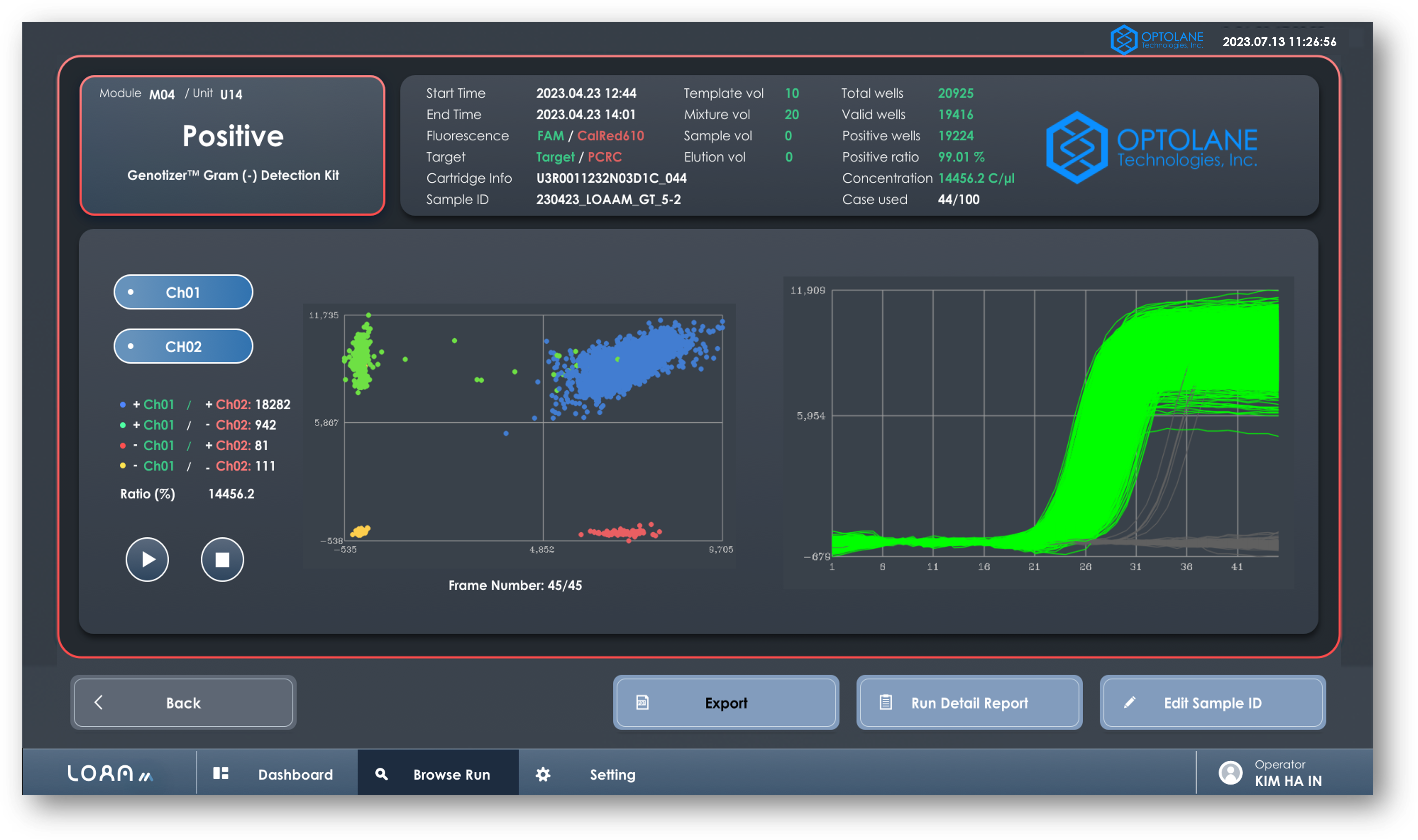
Led development of the full Qt-based operator UI for Linux and Windows. Designed real-time diagnostic data visualization, instrument control screens, and result review workflows optimized for clinical lab operators.Linux 및 Windows용 Qt 기반 운영자 UI 전체 개발을 주도했습니다. 실시간 진단 데이터 시각화, 기기 제어 화면, 임상 실험실 운영자에 최적화된 결과 검토 워크플로를 설계했습니다.
AWS Network IntegrationAWS 네트워크 연동
Built cloud data integration connecting LOAA-M instruments to AWS servers using Java on Windows. Implemented secure diagnostic data upload, retrieval, and multi-site synchronization across networked laboratory environments.Java를 사용하여 LOAA-M 기기와 AWS 서버를 연결하는 클라우드 데이터 연동을 구축했습니다. 보안 진단 데이터 업로드, 조회, 네트워크 연결 실험실 환경에서의 다중 사이트 동기화를 구현했습니다.
Cybersecurity Architecture사이버 보안 아키텍처
Designed and implemented the medical-grade security stack: equipment and network communication encryption, database access control with role-based permissions, and stored data encryption — fully compliant with CE-IVDR and MFDS cybersecurity requirements.의료 등급 보안 스택을 설계하고 구현했습니다: 기기·네트워크 통신 암호화, 역할 기반 권한의 데이터베이스 접근 제어, 저장 데이터 암호화 — CE-IVDR 및 MFDS 사이버 보안 요건을 완전히 충족합니다.
Impact & Achievement성과 & 달성
- Cross-platform Qt UI deployed on both Linux and Windows clinical environments with stable long-term operation크로스 플랫폼 Qt UI — Linux 및 Windows 임상 환경 모두에 배포, 안정적 장기 운용 중
- AWS cloud integration enabling multi-site diagnostic data sharing and remote result accessAWS 클라우드 연동 — 다중 사이트 진단 데이터 공유 및 원격 결과 접근 가능
- End-to-end encryption across device, network, and database layers meeting medical device security standards엔드투엔드 암호화 — 기기·네트워크·데이터베이스 레이어 전반에 걸쳐 의료기기 보안 기준 충족
- CE-IVDR and MFDS certification documentation prepared covering UI scenarios, security architecture, and data managementCE-IVDR 및 MFDS 인증 문서 작성 — UI 시나리오, 보안 아키텍처, 데이터 관리 망라
- MariaDB optimization for high-throughput diagnostic data storage with secure access controls and performance tuningMariaDB 최적화 — 고처리량 진단 데이터 저장, 보안 접근 제어, 성능 튜닝
Key decisions & tradeoffs핵심 의사결정 및 트레이드오프
Why a native Qt desktop stack rather than a web-first UI?웹 우선 UI 대신 네이티브 Qt 데스크톱 스택을 택한 이유는?
Native Qt, offline-first. Low-latency access to device drivers, deterministic real-time behaviour, and identical UI across Linux and Windows clinical machines — no browser runtime in the loop.네이티브 Qt, 오프라인 우선. 장치 드라이버에 저지연으로 접근하고 결정적 실시간 동작을 보장하며, Linux·Windows 임상 장비에서 동일한 UI를 제공합니다 — 브라우저 런타임이 개입하지 않습니다.
A web UI — faster to iterate and style, but it adds network and browser-update dependencies that a certified clinical workflow cannot absorb.웹 UI — 반복 개발과 스타일링은 빠르지만, 인증된 임상 워크플로가 감당할 수 없는 네트워크·브라우저 업데이트 의존성이 생깁니다.
Tradeoff accepted:감수한 트레이드오프: slower UI iteration and per-platform build work, in exchange for behaviour that stays identical between validation and the field.UI 반복 속도 저하와 플랫폼별 빌드 부담 — 검증 시점과 현장에서 동작이 동일하게 유지되는 대가로 수용했습니다.
Security controls vs. operator workflow speed보안 통제 vs. 운영자 워크플로 속도
Security scaled to the action. Routine runs stay one-click; only result modification and system configuration trigger an explicit credential challenge, on top of role tiers (pathologist / technician / admin).행위 위험도에 비례한 보안. 일상 실행은 원클릭으로 두고, 결과 수정과 시스템 설정에만 명시적 자격증명 확인을 요구합니다. 역할 계층(병리의 / 기술자 / 관리자) 위에 적용됩니다.
Uniform strong authentication on every action — maximally safe on paper, but it taxes high-volume routine work and invites workarounds.모든 동작에 동일한 강한 인증 — 서류상 가장 안전하지만 대량 반복 작업에 부담을 주고 우회를 유발합니다.
Tradeoff accepted:감수한 트레이드오프: a context-sensitive policy is more work to specify and audit than one blanket rule — justified by keeping result tampering behind a hard gate without slowing the lab.일괄 규칙보다 정책 명세·감사 비용이 큽니다 — 실험실 속도를 늦추지 않으면서 결과 조작만 확실히 차단하기 위해 감수했습니다.
How CE-IVDR / MFDS shaped the cloud & network architectureCE-IVDR / MFDS가 클라우드 & 네트워크 아키텍처를 형성한 방식
Private AWS VPC with encrypted point-to-point transport and on-premise retention. Multi-site sync runs over encrypted channels, so diagnostic PCR results never cross an uncontrolled network.프라이빗 AWS VPC에 암호화된 지점간 전송과 온프레미스 보관을 결합했습니다. 다중 사이트 동기화도 암호화 채널로 처리해 진단 PCR 결과가 통제되지 않은 네트워크를 지나지 않습니다.
Managed third-party cloud services — cheaper and quicker to stand up, but CE-IVDR and MFDS prohibit real-time export of diagnostic data to non-certified providers.관리형 제3자 클라우드 서비스 — 저렴하고 빠르게 구축되지만, CE-IVDR·MFDS는 미인증 사업자로의 진단 데이터 실시간 반출을 금지합니다.
Tradeoff accepted:감수한 트레이드오프: more infrastructure to own and operate — the cost of meeting data-residency rules while still sharing results across sites inside the organization's firewall.직접 보유·운영해야 할 인프라 증가 — 데이터 상주 규정을 지키면서 조직 방화벽 내에서 사이트 간 결과 공유를 가능하게 하는 대가입니다.
LOAA-M PCR Instrument — Clinical deploymentLOAA-M PCR 기기 — 임상 배포
Qt UI — Real-time diagnostic interfaceQt UI — 실시간 진단 인터페이스
Deep Learning Breast Cancer Targeting Model 딥러닝 기반 유방암 표적화 모델
Objective목표
Develop a deep learning model for breast cancer prediction, applying advanced targeting techniques to push accuracy beyond baseline EfficientNet-B2 performance.딥러닝 기반 유방암 예측 모델을 개발하고, 고급 표적화 기법을 적용하여 기준 EfficientNet-B2 성능 이상의 정확도를 달성했습니다.
Approach & Result접근법 & 결과
- Designed breast cancer prediction model based on EfficientNet-B2, achieving initial accuracy of 86%EfficientNet-B2 기반 유방암 예측 모델 설계, 초기 정확도 86% 달성
- Applied probability-density–based targeting enhancement techniques to improve model focus on high-risk regions확률 밀도 기반 표적화 향상 기법 적용으로 고위험 영역에 대한 모델 집중도 향상
- Improved accuracy to 93% — a 7 percentage-point gain through targeted enhancement표적화 향상을 통해 정확도를 93%로 개선 — 7%p 향상